
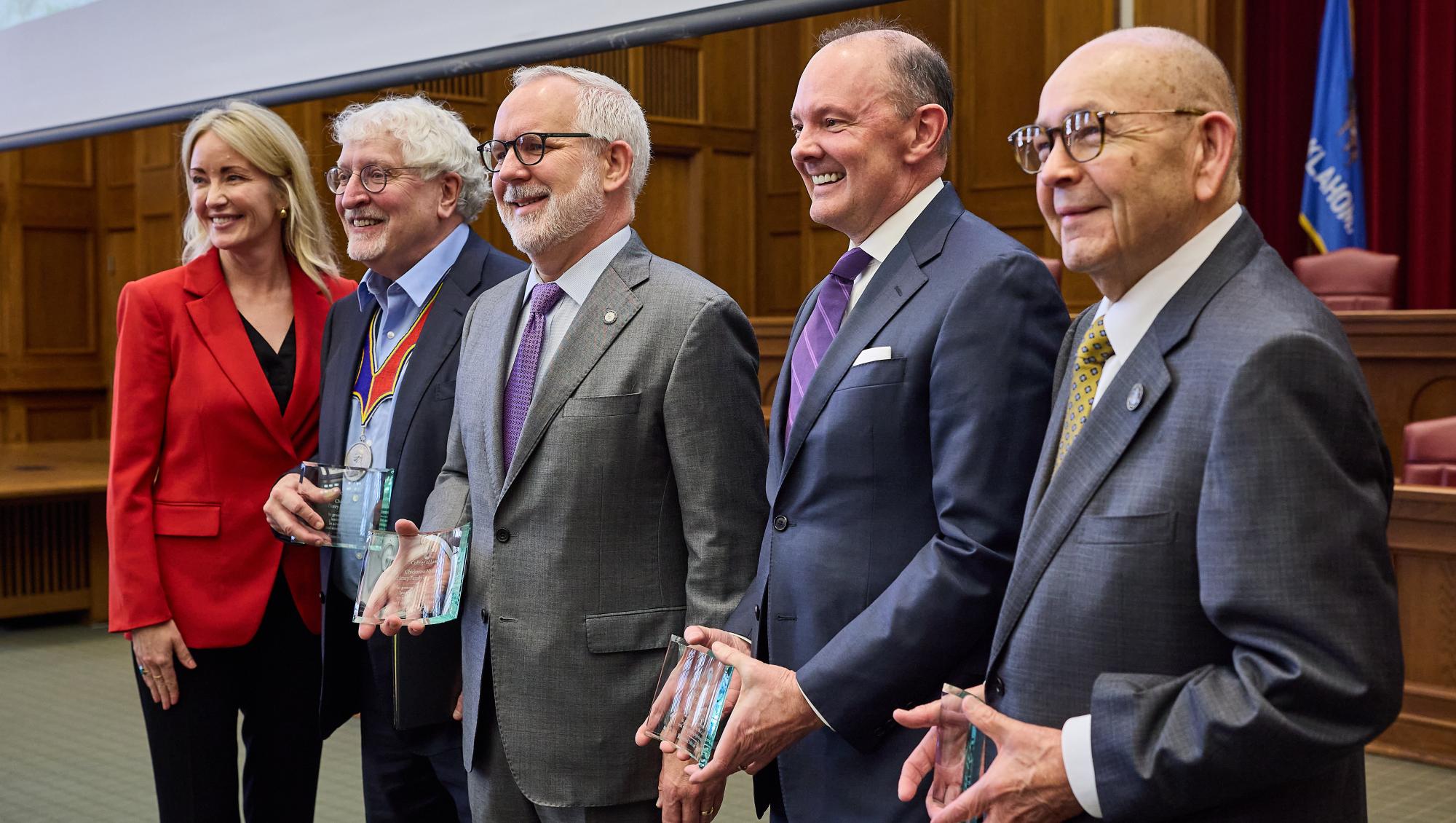
On February 12, 2026, more than 100 students, alumni, faculty, and community members gathered at the University of Oklahoma College of Law for the first program under the newly expanded Chickasaw Nation – Henry Family Lecture Series. You can view the entirety of the presentation here:
The event marked the 18th lecture in a series originally established in 2000 by the Henry family to inspire and educate future lawyers, scholars, and public servants. With the support of the Chickasaw Nation, the program has entered a new era, which builds on a distinguished legacy while deepening the College’s longstanding leadership in Native American law.
In her opening remarks, Dean Anna Carpenter reflected on the history and national stature of the lecture series, which has previously welcomed several sitting and retired United States Supreme Court justices. She emphasized both the Henry family’s vision in establishing the series and the significance of expanding it through partnership with the Chickasaw Nation.
"At OU Law, our strength is our people: students, faculty, staff, alumni, and partners. I’ve said it since I arrived: The support and engagement of our alumni and friends here is truly unparalleled," Dean Carpenter said. "This event, its inception and now its expansion, is just one example of this support and dedication in action."
Carpenter also noted the Chickasaw Nation’s broad and lasting impact on the College of Law and the University of Oklahoma, including support for the Chickasaw Nation Native American Law Chair, the Native Nations Center for Tribal Policy Research, and the Chickasaw Nation Active Learning Classroom. The expansion of the lecture series reflects that deep and ongoing investment in legal education.
"We could not be more pleased to build upon this foundation started by the Henry family with the support of the Chickasaw Nation, which has long been a part of OU’s success," Carpenter said.
Additionally, Judge Robert Henry (OU Law ’77), offered remarks that underscored the program’s enduring purpose and personal significance.
"This lecture series began many years ago to celebrate the deanship of Andy Coats and to give my family the opportunity to give back to our alma mater," Judge Henry said. "I cannot imagine anyone more qualified or better to deliver the Chickasaw Nation Henry Family Lecture than Professor Kevin Washburn. He has been a very successful dean at two law schools, a senior government official, and a terrific teacher and scholar. He will be president of the American Association of Law Schools in 2027. He is brilliant, wise, and a truly decent human being."
Washburn’s lecture examined the renaissance of Tribal governments over the past half century and the resulting impact on federal Indian law, including the increasing number and complexity of cases before the United States Supreme Court. Framing his remarks through the lens of Tribal self-determination, Washburn reflected on moments of pivotal leadership that reshaped governance in Indian Country.
He shared a personal story about Chickasaw Nation Governor Bill Anoatubby’s decision to assume control of the Carl Albert Indian Hospital in Ada from the Indian Health Service. As Professor Washburn discussed, this was a move that, at the time, faced skepticism from some in the community but ultimately became emblematic of Tribal self-governance in action.
"Governor Anoatubby was determined. He stuck his neck out politically, and I assure you, if it hadn't gone well, he wouldn't have been reelected." Professor Washburn said. "But Governor Anoatubby was in charge, so it didn't go wrong. It went right. . . . The Chickasaw people have been very loyal to Governor Anoatubby because he believed in us even when we didn't believe in ourselves."
Over the course of his presentation, Professor Washburn covered the nineteen most recent Supreme Court cases that touch on tribal sovereignty and issues in Indian Country. Through these cases, Washburn illuminated a shift in the way the Supreme Court views Indian Law.
"None of these cases fully showcase the vibrancy of tribes . . . but I think what we've seen is they're winning. They're winning in the Supreme Court." Professor Washburn said. "Tribes had lost 82% of the cases they brought before the court in the 1990s. That figure has just about reversed."
Oklahoma is home to nearly 40 Tribal Nations and the second-largest Native American population in the country, making Indian law a vital and evolving field that touches virtually every area of practice in the state. The Chickasaw Nation – Henry Family Lecture Series reflects OU Law’s continued commitment to that field and to preparing graduates to engage thoughtfully with complex questions of sovereignty, governance, and justice.
Through the combined generosity and leadership of the Henry family and the Chickasaw Nation, the lecture series not only honors a proud tradition, but also ensures its continued growth and relevance for future generations of the OU Law community.
About the University of Oklahoma
Founded in 1890, the University of Oklahoma is a public research university located in Norman, Oklahoma. As the state’s flagship university, OU serves the educational, cultural, economic and health care needs of the state, region and nation. For more information about the university, visit www.ou.edu.